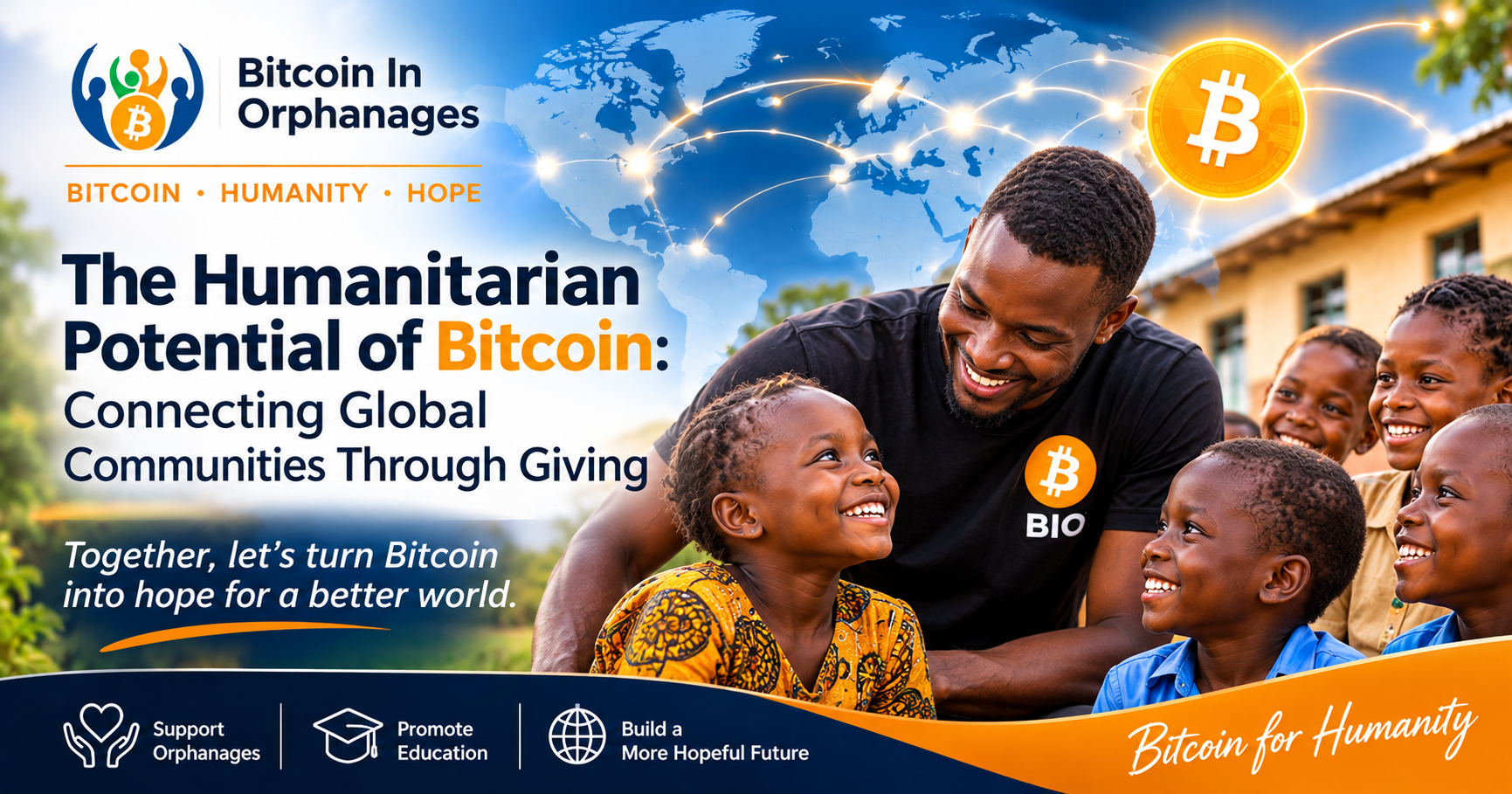
Bitcoin is often discussed through the language of markets, technology, investment and financial independence. Yet beyond these conversations lies another possibility: the ability to connect people across borders around something more meaningful than financial gain.
A person in Europe, a developer in North America, a Bitcoin holder in Asia and a humanitarian initiative in Africa may have very different backgrounds. They may never meet, share the same language or live under the same economic conditions. But they can still contribute to a common purpose.
This is where the humanitarian potential of Bitcoin deserves greater attention.
Bitcoin humanitarian projects are not simply about sending digital money from one country to another. They are about creating new ways for communities to support people in need, mobilize resources, exchange knowledge and turn shared values into practical action.
At a time when humanitarian organizations face funding pressures, communities continue to experience poverty, and millions of children still lack access to essential opportunities, the Bitcoin community has an opportunity to look beyond the financial dimension of the technology.
The question is no longer only what Bitcoin can do for individuals. It is also what people can do together through Bitcoin.
Bitcoin Is More Than a Financial Technology
Bitcoin introduced a global, open monetary network that allows people to transfer value without relying on a traditional banking intermediary for every transaction.
This characteristic has important implications for international giving.
Traditional humanitarian donations often depend on payment providers, banking relationships, currency conversion and financial infrastructure that may not be equally accessible everywhere. These systems remain essential to humanitarian work, but they can create practical challenges when donors and beneficiaries are located in different countries.
Bitcoin offers an additional way to move value across borders.
A donor can send Bitcoin from a personal wallet to an organization or an initiative that accepts it. Transactions can be independently verified on the Bitcoin blockchain, while the Lightning Network provides another payment layer designed for faster, smaller Bitcoin transactions.
However, technology alone does not create humanitarian impact.
A successful donation still requires an organization capable of receiving the funds, managing them responsibly, understanding local needs and delivering assistance. The technology can facilitate a contribution, but people and local institutions must turn that contribution into something useful.
That distinction is fundamental.
The humanitarian value of Bitcoin should not be measured only by the amount transferred, but by what responsible organizations and communities are able to accomplish with it.
The Power of a Global Bitcoin Community
One of Bitcoin's most interesting characteristics is the community that has grown around it.
Developers, educators, miners, entrepreneurs, businesses, investors, open-source contributors and everyday users participate in an ecosystem that extends far beyond national borders.
They do not all share the same motivations. Some are interested in financial sovereignty. Others focus on privacy, technology, economic freedom, education or building new services.
But these different perspectives can come together around a humanitarian objective.
A Bitcoin community can contribute in several ways:
-
Financial support: Individuals can donate Bitcoin to humanitarian initiatives working on concrete needs.
-
Technical knowledge: Developers and experienced users can help organizations understand wallets, payment systems and Bitcoin security.
-
Education: Community members can share practical knowledge about Bitcoin and responsible digital financial practices.
-
Visibility: Content creators, media platforms and community leaders can introduce humanitarian projects to audiences that may never have encountered them.
-
Partnerships: Bitcoin businesses and organizations can explore ways to support humanitarian work through expertise, resources or responsible collaboration.
This is an important shift in perspective.
A community does not have to be physically located in the same country to support a local cause. It can use its networks, knowledge and resources to help initiatives respond to needs on the ground.
But international support should never replace local participation. The people closest to a problem must remain central to understanding it and deciding what kind of assistance is appropriate.
The strongest humanitarian projects are not built by outsiders making decisions for communities. They are built through cooperation with the people those projects are intended to support.
From Bitcoin Donations to Real Humanitarian Action
A Bitcoin donation is a starting point, not the final objective.
For humanitarian initiatives, the real challenge is converting financial contributions into meaningful support.
Consider the needs of children living in orphanages and vulnerable communities. Their daily needs are not abstract. They include food, clean water, clothing, healthcare, school materials, safe living conditions and access to education.
A contribution can help support one of these needs, but only when the organization understands the situation and has a practical plan for using the resources.
This is where Bitcoin humanitarian projects can become particularly relevant.
An initiative may receive support from people across different countries and direct that support toward locally identified priorities. A donor does not necessarily need to live near an orphanage to contribute to an educational or food-assistance objective.
The connection is digital, but the purpose is deeply human.
For this model to work, however, several elements must come together:
-
A clearly defined humanitarian need.
-
A credible local implementation process.
-
A reliable way to receive and manage contributions.
-
Proper documentation of expenses and activities.
-
Communication that allows supporters to understand what has actually been accomplished.
Without these elements, a donation risks remaining a transaction without a clearly demonstrated outcome.
With them, digital contributions can become part of a more organized and accountable approach to humanitarian assistance.
What Is Already Happening in the Humanitarian Bitcoin Ecosystem?
The relationship between Bitcoin and humanitarian work is no longer purely theoretical. Several organizations have begun exploring practical applications.
One notable example is Save the Children.
The organization began accepting Bitcoin donations in 2013, responding to the humanitarian crisis following Typhoon Haiyan in the Philippines. In July 2024, Save the Children and Fedi announced a collaboration exploring the use of Bitcoin and community-based digital tools in cash and voucher assistance in the Philippines.
The initiative aimed to give selected communities access to Bitcoin-based assistance while providing education on how to use the technology and exchange Bitcoin for local currency when necessary.
In December 2025, Save the Children announced the launch of its Bitcoin Fund, developed with Fortris. The initiative was designed to allow the organization to hold Bitcoin donations for a period of up to four years and explore additional ways to use Bitcoin and digital wallets in humanitarian assistance.
These developments are important because they demonstrate that the discussion is moving beyond simply accepting cryptocurrency donations. Humanitarian organizations are also examining how Bitcoin and related technologies might support financial operations and the delivery of assistance.
There is another important distinction: not every blockchain-based humanitarian initiative is a Bitcoin project. UNICEF's Innovation Fund, for example, has explored blockchain-based solutions for social impact, including accountability and financing. Such work illustrates a broader interest in digital infrastructure, but it should not automatically be presented as evidence of Bitcoin adoption.
The lesson is not that every humanitarian organization should adopt Bitcoin.
It is that organizations should be willing to examine new tools when those tools can address real operational needs, while remaining responsible about their limitations.
Why Africa Should Be Part of This Conversation
Africa deserves a central place in discussions about the humanitarian potential of Bitcoin.
Across the continent, communities face different combinations of economic, educational, healthcare and infrastructure challenges. These challenges cannot be reduced to a single narrative, and no technology can solve them independently.
Yet Africa is also home to entrepreneurs, developers, educators, community organizers and young people building new opportunities.
Bitcoin can be part of this wider conversation about access, knowledge and participation.
For humanitarian initiatives working with orphanages and vulnerable communities, the possibilities extend beyond receiving donations.
Bitcoin education can introduce people to a new financial technology. Digital literacy can help young people understand how digital systems work. Access to knowledge and practical skills can create opportunities that go beyond immediate humanitarian assistance.
This requires a responsible approach.
Bitcoin education should not be confused with encouraging vulnerable people to speculate on cryptocurrency prices. Children and communities should not be exposed to unnecessary financial risks or presented with Bitcoin as a guaranteed path to prosperity.
The priority must remain education, understanding and informed participation.
Humanitarian work should respond to people's actual needs, not use those needs as an excuse to promote a technology.
Transparency: The Foundation of Trust
If Bitcoin is going to play a meaningful role in humanitarian giving, transparency must be part of the conversation from the beginning.
One of Bitcoin's distinctive characteristics is that transactions recorded on its public blockchain can be independently examined. This can help verify that a transaction occurred between particular addresses at a particular time.
But blockchain visibility is not the same as humanitarian accountability.
A public transaction does not automatically reveal who ultimately received the funds, what goods were purchased, whether the prices were reasonable or whether the intended beneficiaries received the assistance.
That is why responsible humanitarian initiatives need more than transaction records.
They need clear objectives, financial reporting, expense documentation, mission records and evidence of activities.
A donor should be able to understand:
-
What need is the initiative addressing?
-
What is the objective of the project?
-
How are contributions being managed?
-
What expenses have been incurred?
-
What activities have actually taken place?
-
What evidence is available to support the reported results?
Transparency should not be treated as a marketing promise. It should be part of the organization's working process.
It also requires respect for privacy. Publishing evidence does not mean exposing children's identities, medical information, personal details or sensitive financial data.
Trust is built when organizations communicate honestly about both their achievements and their limitations.
BIO: Connecting the Bitcoin Community With Humanitarian Needs
Bitcoin In Orphanages (BIO) was created around a simple but important idea: connecting the Bitcoin community with orphanages, vulnerable children and communities facing humanitarian needs.
BIO explores how Bitcoin can support humanitarian action beyond its financial use.
Its work brings together several areas: humanitarian assistance, Bitcoin donations, education, community engagement and financial transparency.
The initiative's public mission identifies needs such as food assistance, school supplies, education, healthcare-related support, access to drinking water and opportunities for underprivileged children.
These are not merely categories on a website. They represent everyday challenges that require attention, resources and practical responses.
BIO's approach is to connect people who believe in the potential of Bitcoin with humanitarian initiatives that can respond to those needs.
This connection can take different forms.
A Bitcoin holder may contribute financially. A developer may share technical knowledge. An educator may help explain how Bitcoin works. A business may explore a responsible partnership. A member of the community may help make a humanitarian initiative more visible.
Each contribution can play a different role.
The objective is not to turn humanitarian work into a Bitcoin promotion campaign. It is to demonstrate that a community built around an open financial technology can also become involved in supporting real people and practical causes.
BIO also emphasizes transparency through its public financial transparency initiative and humanitarian objectives. This is important because supporters should be able to distinguish between a stated objective, a donation received, an expense recorded and an activity actually completed.
These are different stages, and communicating them accurately is essential.
The credibility of a humanitarian initiative does not come from the technology it uses or the size of its ambitions. It comes from the consistency between its mission, its actions and the evidence it can provide.
The Challenges We Must Not Ignore
The humanitarian potential of Bitcoin is real, but it should be discussed without exaggeration.
There are practical challenges that organizations and donors must understand.
Volatility
Bitcoin's market value can change significantly. An organization that receives Bitcoin must decide whether to hold it, convert it or use it directly. Each choice has financial and operational implications.
Access to technology
Bitcoin requires appropriate devices, connectivity and knowledge. Communities without reliable internet access or digital infrastructure may not be able to use Bitcoin directly.
Security
Wallet management, private keys, backups and transaction verification require care. Losing access to a wallet can mean losing access to its funds. Humanitarian organizations need clear security procedures.
Local regulations
Rules governing cryptocurrency donations, exchanges, custody and nonprofit activities vary from country to country. Organizations must understand the legal requirements that apply to their operations.
Local needs come first
Not every beneficiary needs Bitcoin, and not every humanitarian situation is suited to digital payments. In some circumstances, food, medicine, cash assistance or traditional banking services may be more appropriate.
Responsible adoption means choosing the right tool for the situation, not forcing every situation to fit the tool.
Bitcoin should serve humanitarian objectives. Humanitarian objectives should never be distorted to serve Bitcoin.
Building a Stronger Connection Between Technology and Humanity
The future of Bitcoin humanitarian projects will depend on more than the development of wallets, payment infrastructure or donation platforms.
It will depend on the people who decide to use these tools responsibly.
The Bitcoin community has resources that extend beyond financial capital. It has technical expertise, international networks, educational initiatives, communication channels and a culture of collaboration.
These resources can become valuable when they are connected with local organizations that understand the realities of the communities they serve.
The next stage of Bitcoin philanthropy should therefore focus on cooperation.
Bitcoin businesses can help improve access to reliable payment infrastructure. Developers can contribute to practical solutions. Educators can make the technology easier to understand. Donors can support projects with clear objectives. Humanitarian initiatives can document their work and communicate honestly about the use of resources.
This is how a global community can become more than an audience or a collection of individual supporters.
It can become a network of people working together around shared humanitarian priorities.
Conclusion: Bitcoin Has a Human Side
Bitcoin's story is still developing.
Its role in finance, technology and economic freedom continues to attract attention. But its humanitarian potential deserves an equally serious conversation.
A global network can connect people who would otherwise remain separated by distance, financial systems and national borders. Through responsible giving, education and cooperation, that connection can help support initiatives working with vulnerable communities.
The most important question is not how much attention Bitcoin receives.
It is whether the people and organizations using it can turn its possibilities into meaningful, verifiable action.
At Bitcoin In Orphanages, we believe the Bitcoin community can contribute to something bigger than the technology itself: a world in which knowledge, generosity and collective action help create better opportunities for children and vulnerable communities.
Bitcoin can connect the world. What we choose to do with that connection is what gives it purpose.
Discover the BIO mission, explore its humanitarian objectives and learn how you can become part of a community connecting Bitcoin with humanitarian action.
Bitcoin In Orphanages — Bitcoin for Humanity, Beyond Borders.