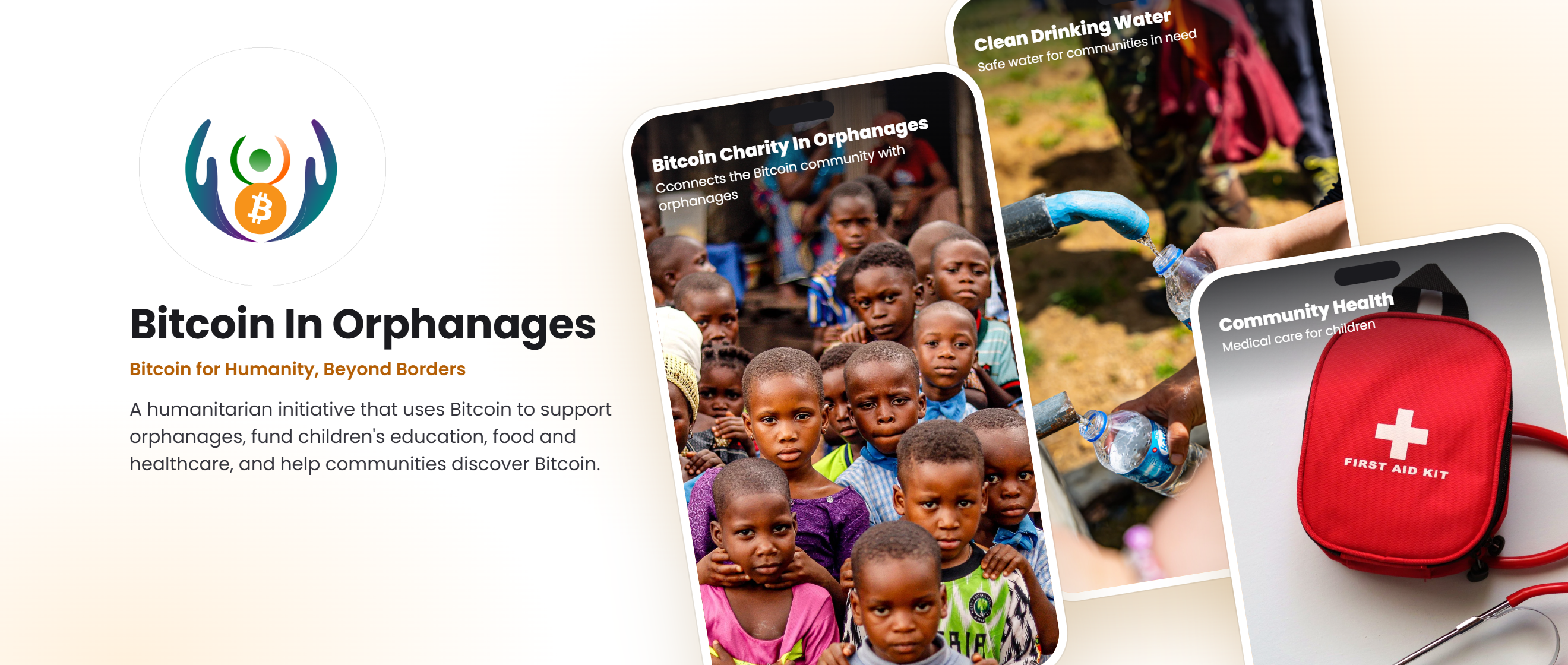
Bitcoin charity stopped being a thought experiment the moment someone used it to feed a child. At Bitcoin In Orphanages (BIO), that is the whole point: a supporter anywhere in the world sends Bitcoin, and it turns into school supplies, meals, medical care and Bitcoin education for children who grew up without a family to lean on.
BIO is a humanitarian initiative that connects the Bitcoin community with orphanages, vulnerable children and communities in need. It works through three things: Bitcoin donations, education and documented field missions. Its aim, in its own words, is to build "a community where every child, regardless of background, can learn, grow, and build a life of dignity."
This article explains how BIO approaches Bitcoin humanitarian aid, how its Bitcoin donation platform works, why the model suits Bitcoin orphanages in Africa and beyond, and what it asks of partners and supporters. Bitcoin for good is easy to say. BIO tries to make it measurable.
Why Bitcoin fits humanitarian aid
Traditional international giving can be slow, expensive and tied to a bank account in the right country. Crypto charity changes that equation, and BIO builds on three practical strengths of Bitcoin.
- No borders. A supporter in Europe, the Americas or Asia can send Bitcoin to BIO without relying only on international bank transfers. BIO's mission form lists 43 countries, and its FAQ says supporters from any country can sponsor a mission remotely.
- Speed and small amounts. The Lightning Network allows fast, low-cost payments, so even a small gift counts. That matters when a single school kit or a hot meal is what a child needs.
- Verifiable transactions. Bitcoin payments can be independently checked on the blockchain. BIO adds its own financial reports on top, so a donor can follow both the money and the action it paid for.
BIO is also realistic about the trade-offs. It states that responsible custody and security are essential when an organization holds Bitcoin, and it warns supporters to send funds only to the payment details published on its official website, never to personal accounts or to people claiming to represent BIO. That mix of openness and caution is what makes Bitcoin humanitarian aid credible. Bitcoin is the rail. The humanitarian work is what travels on it.
What BIO does: Bitcoin charity projects built around children
BIO is led by its founder, G. Maurice, with a core team that covers design, media, field support, Bitcoin education, content and community support. The project lists 15 active locations: Benin (its base), Togo, Ghana, Niger, Nigeria, Mali, Burkina Faso, Cameroon, Gabon, Côte d'Ivoire, Madagascar and Tanzania in Africa, plus France, Italy and Argentina.
Its Bitcoin humanitarian projects go further than emergency relief. BIO wants to strengthen orphanages and open long-term opportunities, and it organizes its work around four pillars:
- Education: school materials, books, libraries, scholarships and digital learning.
- Protection: safety, care and healthier orphanage environments.
- Technology: computers, internet and digital skills for learning and future jobs.
- Financial inclusion: Bitcoin as a way for supporters worldwide to contribute.
On the ground, BIO's Bitcoin charity projects cover food assistance, school enrollment, school supplies, community health, access to drinking water, emergency aid, social services and community development. Donations can also go to computer labs, solar power and internet access, orphanage renovations, clothing and blankets, and professional training in areas such as web development, AI and entrepreneurship.
BIO also sets public yearly targets. These are goals, not results: 100 humanitarian actions, 12 orphanages, 50 scholarships or sponsorships, 50 professional training programs and Bitcoin education for 1,000 people.
How to make Bitcoin donations through BIO
BIO's Bitcoin donation platform lives on its BIOPAY page, and it offers several ways to give so that supporters can pick what suits their wallet:
- On-chain Bitcoin (BTC): send to BIO's published Bitcoin address.
- Lightning Network: pay a Lightning invoice or use BIO's Lightning address for fast, low-fee gifts and small amounts in satoshis.
- QR invoice: generate a Bitcoin payment QR code and scan it with a Lightning wallet.
- Card: a credit card donation through Stripe, for supporters who do not hold Bitcoin yet.
Always copy the payment details directly from the official BIOPAY page at biofound.org, as BIO itself advises.
Give to something concrete
You do not have to donate an abstract sum. BIOPAY lists products priced in sats, each tied to a real need, and supporters can "zap" them over Lightning. A few examples:
- Enrolling one child in school: 300,000 sats
- Medical care support for one child: 50,000 sats
- A meal drive for an orphanage, a school or a family: 350,999 sats
- Bitcoin learning materials: 10,000 sats
- Children's recreation and sports equipment: 30,000 sats
- Supplying one orphanage with bulk food and hygiene goods: 1,625,000 sats
Order a mission
Supporters can also sponsor a specific action. BIO's mission form offers 13 types, from distributing food, clothing or school supplies to supporting a child's education, donating drinking water, organizing a Bitcoin session, renovating a center or supporting a family in need. You fill in the form, pay in Bitcoin or by card, and BIO's team reviews the request and confirms it is feasible. You can name a specific orphanage or community, and proof of work is sent back by email, WhatsApp, Telegram or another channel you choose.
Bitcoin charity in Africa: where BIO is rooted
Africa is the heart of BIO's footprint. Twelve of its 15 active locations are African countries, and its base is in Benin, in West Africa. For Bitcoin charity in Africa, that is important for a simple reason: many orphanages on the continent are small, independent and challenging to reach with international bank transfers.
BIO's answer is to help orphanages receive international support directly, through Bitcoin and modern technology, while connecting them with donors across the world. On its site, the Africa focus is described as supporting education, nutrition and healthcare. Bitcoin humanitarian Africa work, for BIO, means the practical basics first:
- Meals and food supplies for children in orphanages
- School kits, uniforms and learning materials
- Medical consultations, medicines and urgent treatment
- Access to clean drinking water, including filtration, wells and sanitation
- Solar power and internet access, so orphanages can connect to digital learning
The same logic shows up in emergencies. BIO runs an emergency page where a supporter can pay over Lightning to help a specific case. A recent campaign, for instance, raises funds for urgent surgery for a four-year-old boy in Benin. It shows how Bitcoin donations Africa-wide can be directed to a single, verifiable need instead of disappearing into a general fund.
For Bitcoin orphanages Africa-wide, the long-term hope goes beyond aid. BIO wants Bitcoin and digital skills to become part of what children learn, so that orphanages gain tools for the future and not only supplies for today.
Transparency: showing where Bitcoin donations go
A Bitcoin donation platform earns trust only if donors can see what happens next. BIO publishes a transparency page where each objective has its own budget, its own donation progress and its own verified expenses. Only verified expenses count as public spending, and pending expenses stay out until they are approved.
BIO's 12-month plan sets out five strategic objectives with a combined funding target of €679,592. A sixth, smaller project, Christmas With Bitcoin, brings the total to €682,592. BIO is clear that these are planned targets, not confirmed spending, and that real allocations depend on verified needs and available funding. The BTC values are approximate.
|
Objective |
Who it serves |
Target (EUR) |
Approx. BTC |
|---|---|---|---|
|
Bitcoin Education |
At least 1,000 children and young people a year |
280,592 |
5.00 |
|
BIO Bitcoin Education Center |
An independent, Bitcoin-funded school, mainly for orphanage children |
250,000 |
3.50 |
|
Food Assistance |
At least 1,000 children a year |
92,000 |
1.50 |
|
Healthcare Assistance |
Children in orphanages and vulnerable communities |
32,000 |
0.60 |
|
School Supplies Support |
At least 1,000 children a year |
25,000 |
0.47 |
|
Christmas With Bitcoin |
At least 90 of 100 children at one orphanage |
3,000 |
0.04 |
Proof of work
BIO commits to publishing reports after missions, photos and videos, public donor updates, expense documentation and annual impact reports. Its Proof of Work page already shows two completed actions published on 8 May 2026: school kits distributed to 54 children living in an orphanage, and a meal distribution supporting families in need and orphanages, both with photos and videos. The page also lists the areas where no action has been recorded yet, which is itself a sign of honest reporting.
That last point deserves emphasis. A young project that shows what it has not done yet is easier to trust than one that claims everything.
Bitcoin partnerships, NGOs and the community behind BIO
No humanitarian project reaches children alone. BIO is built to work with others, and its partnership page lays out eight ways to get involved:
- Companies: funding, sponsorship or professional expertise.
- NGOs and foundations: joint humanitarian projects for children. This is where Bitcoin NGOs and traditional charities can meet.
- Institutions: support for educational, social and humanitarian projects.
- Bitcoin community: advancing humanitarian work through Bitcoin technology.
- Technology: digital solutions that help orphanages.
- Logistics: transporting and distributing aid.
- Education: funding children's schooling, training and future.
- Individuals: a personal commitment to improving the lives of orphans.
The partnership form lets a supporter choose from 22 forms of help, among them a Bitcoin donation, a monthly gift, a grant, infrastructure financing, equipment or food donations, volunteering, team travel, a charity concert or becoming a BIO ambassador. Partners can also join emergency campaigns, and BIO promises regular reporting and responsible management in return.
This is how Bitcoin community humanitarian projects take shape in practice. A developer can contribute a digital tool, a Bitcoin company can fund a program, a teacher can run a session, and a volunteer group can carry supplies. BIO says it is open to partnerships with Bitcoin companies, developers, miners, universities, businesses and humanitarian organizations. Its site does not yet name individual partners, and that is worth knowing: the doors are open, and the partnership list is still being built.
For anyone looking at Bitcoin partnerships with a purpose, the process is simple. Choose a partnership type, fill in the request form, say how you want to help, and the BIO team replies.
Bitcoin adoption through humanitarian action
BIO has a second ambition next to helping children today: showing that Bitcoin can do good well beyond trading. Every donation, every mission and every field report is also a small proof that Bitcoin works for people, and that is the most convincing form of Bitcoin adoption humanitarian work can offer.
Education is where the two goals meet. BIO's Bitcoin education program is designed for children and young people, with workshops, learning materials, digital safety and responsible wallet use, adapted to age and learning needs. The target is at least 1,000 children and young people a year, and BIO says it will publish participation figures and learning outcomes. On its site, Bitcoin Classes cover the history, uses and adoption of Bitcoin, and a Bitcoin Awareness section helps communities see practical uses beyond finance.
The longer-term plan is the BIO Bitcoin Education Center: an independent, Bitcoin-funded school, mainly for orphanage children, offering free education, diplomas and professional skills training. It is still a funding goal, and BIO gives no completion date, but it shows where the project wants to go. Children would learn computer science, web development, AI, graphic design and entrepreneurship, and Bitcoin would be part of the toolbox rather than a mystery.
BIO also shares its thinking publicly. Recent updates on its Geyser Fund page cover building a more open humanitarian economy with decentralized technologies and why digital access is becoming essential for children. Supporters can follow the project through its newsletter and on X, Facebook, Telegram, Instagram, YouTube, Nostr and Bluesky.
A new way to give, one child at a time
BIO is a BTC humanitarian project with a plain, human goal: children who deserve the same chances as any others. It uses Bitcoin for orphanages because Bitcoin reaches places and people that traditional giving often misses, and it pairs every transfer with education, field missions and public reporting.
The project is young, and it says so. Its targets are targets, its partner list is still growing and its proof of work is being built mission by mission. That candor is part of why Bitcoin charity Africa-wide and worldwide can grow around it. Crypto humanitarian aid only deserves trust when someone shows the receipts, and BIO has chosen to do exactly that.
How you can take part
- Give: make a Bitcoin, Lightning or card donation on the BIOPAY page at biofound.org/biopay.
- Sponsor a mission: order food, school supplies, clean water or a child's education through the mission form.
- Partner: companies, NGOs, institutions, developers and volunteers can apply on the partnership page.
- Spread the word: follow BIO on its social channels, subscribe to the newsletter or write to contact@biofound.org.
Bitcoin was built to move value without asking permission. BIO asks a simple question of it: what if that value went to a child's school bag, a meal or a doctor's visit? That is what Bitcoin for good looks like in practice.